


It is rare that writers in other nations write a book about the history of Dutch and Spanish rule in Taiwan, with only a few foreign scholars — Leonard Blusse at Leiden University, Tonio Andrade at Emory University, or Jose Eugenio Borao Mateo at National Taiwan University — focusing on the era.
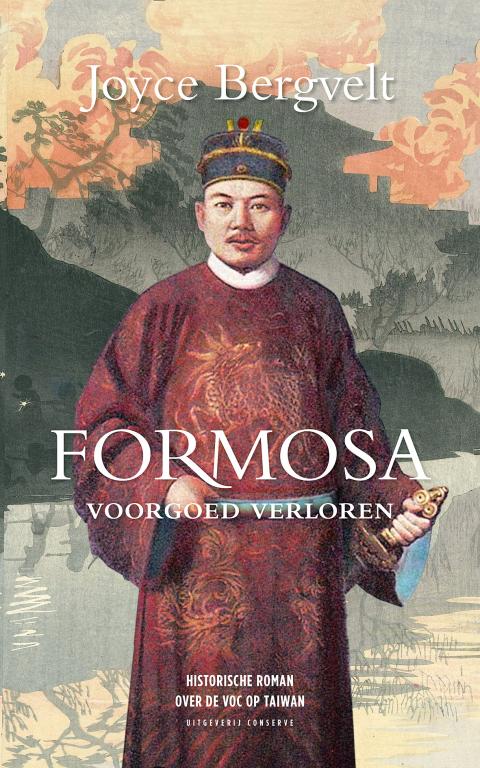
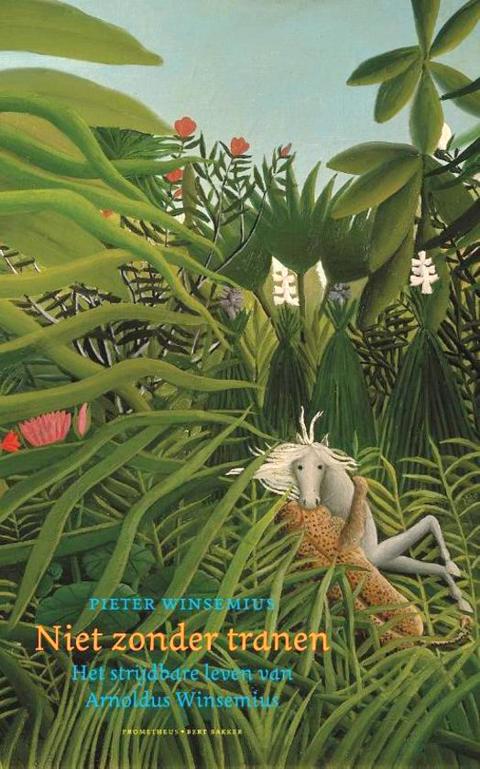
So it is thus quite remarkable that in The Netherlands recently, two writers each published a novel (in Dutch) about events in Taiwan during the period of Dutch rule, from 1624 to 1662. The first is Formosa voorgoed verloren (Formosa lost forever) by Joyce Bergvelt, and the second is Niet zonder tranen; het strijdbare leven van Arnoldus Winsemius (Not without tears, the combative life of Arnoldus Winsemius) by Pieter Winsemius.
Bergvelt became interested in the nation’s history in the early 1980s, when her father served as an executive with the Philips company in Taiwan, and she decided to join her parents and attended National Taiwan Normal University for a year. She became fascinated by the island’s history and wrote a thesis about it during her later studies in the UK. Out of her scholarly work evolved a novel, based on historical facts, to which she added her imagination in order to arrive at a fascinating read, juxtaposing the life of Ming-dynasty warlord and pirate Cheng Cheng-kung (鄭成功, also known as Koxinga) with those of his adversaries on the Dutch side, in particular Swedish-born Frederick Coyett, the last Dutch East India Company governor of Formosa.
Winsemius came to writing his work from a very different background. He served as a minister for urban planning and environment in the Dutch government in the 1980s, and both before and after worked for the consultant company McKinsey. In his free time and after his retirement he was an avid researcher into his family history, and at some point became intrigued by a distant ancestor who was educated as a church minister at Leiden University in the early 1650s, and who at the young age of 22 became a missionary in faraway Formosa, making the long trip by ship to the Far East with his young wife and newborn baby.
His curiosity peaked when he ran into an article by a former Dutch diplomat, Jan Vixseboxse, who related that in 1948 in the archives of the Catholic Cathedral in Chinese Nationalist Party (KMT)-controlled Beijing he had discovered a 17th century Bible, which contained a personal diary by Reverend Arnoldus Winsemius. Vixseboxse was able to take a few pictures of key pages, and many years later published an article about it. The archives and the bible were subsequently lost in the chaos that engulfed China during the Cultural Revolution.
Based on this new evidence, and on long hours of research in the archives of the Dutch East India Company from both Batavia and Formosa (which are available at the National Archives in The Hague), Winsemius pieced together a new diary of his ancestor, based on historical facts, to which he added a highly personal interpretation of what happened in the everyday life in the small village a day’s walk from the Dutch fortress Zeelandia (present-day Tainan).
Both works give a fascinating insight into the life and times of the main protagonists. Bergvelt covers Cheng Cheng-kung’s life from his birth in 1624 to a Japanese mother in Nagasaki, through his education and training in China, the betrayal of the Ming cause by his pirate father Cheng Chih-lung (鄭芝龍), his increasingly bitter fight against the newly established Qing dynasty, culminating in his escape across the Taiwan Strait where he laid a nine-month siege of Dutch-held Fort Zeelandia, and his short-lived victory over the Dutch: he died less than a year later.
Winsemius presents a moving insight into the passion and dedication of his missionary ancestor, who gives up a comfortable life in the Netherlands, and adjusts to life in far Formosa to spread the gospel among the Aborigines. Life was not easy: his first child and his wife die of tropical diseases, but he remarries and is successful in attracting local converts to Christianity. The book presents a very sensitive and humoristic account of the interactions between the pastor and the Aborigines, but also of his struggles with bureaucratic wrangling in both state and church in 17th century Formosa.
The life of the young pastor comes to an abrupt end after Cheng Cheng-kung and his troops arrive, and start their siege of Fort Zeelandia. Unfortunately, pastor Arnoldus Winsemius is among about 500 Dutch teachers, pastors, traders and local administrators living dispersed in approximately 40 villages around the fort, not protected by the fort’s walls and big cannons.
Initially, Cheng Cheng-kung allows them some room for maneuver, but after a major battle in mid-September 1661 in which Dutch ships bombard Cheng Cheng-kung’s troops and encampment, he takes revenge on the hapless civilians, has the teachers and pastors rounded up, torturing them by cutting off their ears, noses and hands, and eventually beheading them.
The siege of the fort would continue for four-and-a-half months, until early February 1662, when governor Coyett finally had to surrender, and was allowed to leave for Batavia with the survivors from the fort and surrounding villages. In Batavia, Coyett was court-martialed by his superiors in the East India Company for “losing Formosa” — while they themselves were actually to blame for not sending the much-needed reinforcements Coyett had asked for. He was banned to a small island in the Moluccas, but after 10 years of exile was rehabilitated and returned to the Netherlands, where he wrote a detailed account of the siege ‘t Verwaarloosde Formosa (The Neglected Formosa).
During the past few years, there has been a strong desire in Taiwan to discover the country’s own history, starting from the Aborigines who inhabited the island more than 5,000 years ago. The Dutch period is particularly significant, because it left many written records by Dutch officials, ship captains and missionaries like Winsemius’ ancestor, describing life and customs of the people on the island, and their interaction with the incoming foreigners.
Against this background, the two books are highly valuable contributions to the understanding of life in Taiwan in the 17th century. One hopes that they can be translated into English and even into Chinese, so more people in Taiwan can catch a glimpse of what life was like 400 years ago: actually, the 400th anniversary of the establishment of the Dutch trading post at Fort Zeelandia / Anping is coming up in a few years.
Publication Notes
Formosa voorgoed verloren; historische roman over de VOC op Taiwan (Formosa lost forever; historical novel about the Dutch East India Company in Taiwan)
By Joyce Bergvelt
566 pages
Conserve Publishers, Schoorl, The Netherlands
Hardcopy: The Netherlands
Niet zonder tranen; het strijdbare leven van Arnoldus Winsemius (Not without tears, the combative life of Arnoldus Winsemius)
By Pieter Winsemius
264 pages
Prometheus Publishers
Hardback: Amsterdam

Last week the government announced that by year’s end Taiwan will have the highest density of anti-ship missiles in the world. Its inventory could exceed 1,400, or enough for the opening two hours of an invasion from the People’s Republic of China (PRC). Snark aside, it sounds impressive. But an important piece is missing. Lost in all the “dialogues” and “debates” and “discussions” whose sole purpose is simply to dawdle and delay is what the Chinese Nationalist Party (KMT) alternative special defense budget proposal means for the defense of Taiwan. It is a betrayal of both Taiwan and the US. IT’S
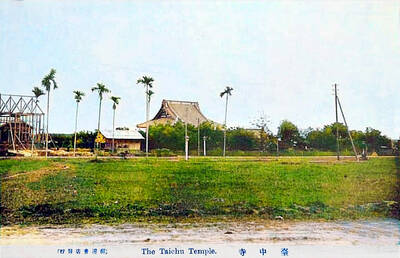
March 16 to March 22 Hidden for decades behind junk-filled metal shacks, trees and overgrowth, a small domed structure bearing a Buddhist swastika resurfaced last June in a Taichung alley. It was soon identified as a remnant of the 122-year-old Gokokuzan Taichuu-ji (Taichung Temple, 護國山台中寺), which was thought to have been demolished in the 1980s. In addition, a stone stele dedicated to monk Hoshu Ono, who served as abbot from 1914 to 1930, was discovered in the detritus. The temple was established in 1903 as the local center for the Soto school

Paul Thomas Anderson’s “One Battle After Another” was crowned best picture at the 98th Academy Awards, handing Hollywood’s top honor to a comic, multi-generational American saga of political resistance. The ceremony Sunday, which also saw Michael B. Jordan win best actor and “Sinners” cinematographer Autumn Durald Arkapaw make Oscar history as the first female director of photography to win the award, was a long-in-coming coronation for Anderson, a San Fernando Valley native who made his first short at age 18 and has been one of America’s most lionized filmmakers for decades. Before Sunday, Anderson had never won an Oscar. But “One Battle

In Kaohsiung’s Indigenous People’s Park (原住民主題公園), the dance group Push Hands is training. All its members are from Taiwan’s indigenous community, but their vibe is closer to that of a modern, urban hip-hop posse. MIXING CULTURES “The name Push Hands comes from the idea of pushing away tradition to expand our culture,” says Ljakuon (洪濬嚴), the 44-year-old founder and main teacher of the dance group. This is what makes Push Hands unique: while retaining their Aboriginal roots, and even reconnecting with them, they are adamant about doing something modern. Ljakuon started the group 20 years ago, initially with the sole intention of doing hip-hop dancing.


 RSS
RSS