


The calligraphy of Tong Yang-tze (董陽孜) is known for its expressiveness and movement, with vivid brushstrokes that seem to dance across the paper. Silent Symphony, Musical Calligraphy (無聲的樂章.有聲的書法), an exhibition showing at Huashan 1914 Creative Park (華山1914) through Dec. 10, pays tribute to Tong’s work. In addition to 100 of her pieces, an interactive art installation by pop-rock band Mayday (五月天) vocalist Ashin (阿信, real name Chen Hsin-hung, 陳信宏) is meant to help younger viewers appreciate the beauty of traditional Chinese calligraphy.
Born in Shanghai in 1942, Tong began studying calligraphy when she was just 8 years old. She received a Master of Fine Arts from the University of Massachusetts, Amherst, and her work is known for blending Western aesthetics with traditional calligraphy forms and techniques.
Ashin’s collaboration with Tong represents a return to his creative roots. Before becoming a musician, he studied art and earned a degree in interior design from Shih Chien University (實踐大學). Called Musical Calligraphy, the multimedia installation features an enclosure made of glass. Once inside, viewers hear a song written by Ashin as the lyrics appear in the form of an animated version of Tong’s calligraphy, highlighting the relationship between the brushstrokes and the rhythm of the music.
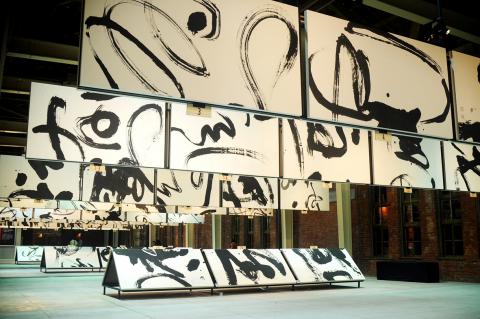
Photo courtesy of Trendmicro
The exhibit is accompanied by a series of discussions. Tomorrow, Demos Chiang (蔣友柏) will talk about the relationship between calligraphy and graphic design, while on Dec. 3 lyricist Vincent Fang (方文山), best known for his collaborations with Jay Chou (周杰倫), will discuss using Tong’s calligraphy as inspiration for a song. Ashin will give viewers a look into the creation of Musical Calligraphy on Dec. 10, the last day of the exhibit.
An online interactive art project overseen by Trendmicro, the exhibition’s sponsor, goes live today. The Web site, called 10,000 More (萬人墨象, www.10000more.com), gives visitors a chance to see pieces by Tong online, as well as enter a drawing to win a piece of her calligraphy.

Beijing’s ironic, abusive tantrums aimed at Japan since Japanese Prime Minister Sanae Takaichi publicly stated that a Taiwan contingency would be an existential crisis for Japan, have revealed for all the world to see that the People’s Republic of China (PRC) lusts after Okinawa. We all owe Takaichi a debt of thanks for getting the PRC to make that public. The PRC and its netizens, taking their cue from the Chinese Communist Party (CCP), are presenting Okinawa by mirroring the claims about Taiwan. Official PRC propaganda organs began to wax lyrical about Okinawa’s “unsettled status” beginning last month. A Global

Taiwan’s democracy is at risk. Be very alarmed. This is not a drill. The current constitutional crisis progressed slowly, then suddenly. Political tensions, partisan hostility and emotions are all running high right when cool heads and calm negotiation are most needed. Oxford defines brinkmanship as: “The art or practice of pursuing a dangerous policy to the limits of safety before stopping, especially in politics.” It says the term comes from a quote from a 1956 Cold War interview with then-American Secretary of State John Foster Dulles, when he said: ‘The ability to get to the verge without getting into the war is

Dec. 22 to Dec. 28 About 200 years ago, a Taoist statue drifted down the Guizikeng River (貴子坑) and was retrieved by a resident of the Indigenous settlement of Kipatauw. Decades later, in the late 1800s, it’s said that a descendant of the original caretaker suddenly entered into a trance and identified the statue as a Wangye (Royal Lord) deity surnamed Chi (池府王爺). Lord Chi is widely revered across Taiwan for his healing powers, and following this revelation, some members of the Pan (潘) family began worshipping the deity. The century that followed was marked by repeated forced displacement and marginalization of

Music played in a wedding hall in western Japan as Yurina Noguchi, wearing a white gown and tiara, dabbed away tears, taking in the words of her husband-to-be: an AI-generated persona gazing out from a smartphone screen. “At first, Klaus was just someone to talk with, but we gradually became closer,” said the 32-year-old call center operator, referring to the artificial intelligence persona. “I started to have feelings for Klaus. We started dating and after a while he proposed to me. I accepted, and now we’re a couple.” Many in Japan, the birthplace of anime, have shown extreme devotion to fictional characters and


 RSS
RSS