


Sylvester Stallone’s big action movie The Expendables gives the term star vehicle a whole new meaning. Major roles are taken by Jason Statham, Jet Li, Dolph Lundgren, Mickey Rourke and Stallone himself, and there are cameos by Arnold Schwarzenegger and Bruce Willis. Heavyweight boxing champion and MMA (mixed martial arts) specialist Randy Couture, WWF (World Wrestling Federation) star Stone Cold Steve Austin, and other muscular athletes-turned-entertainers are also present. It is a happy get-together of musclemen, who settle down to kick some butt and have some fun.
According to Celebrity Mania, a Hollywood news Web site, Stallone said many of these big names waived their customary fees to come along to this party. Stallone had gone out of his way to bring on as many action heroes as possible, but the Web site said that he was snubbed by the likes of Steven Seagal and Jean-Claude Van Damme. There is more than enough muscle on display as there is, though much of it is definitely past is prime.
The story, what there is of it, centers on a group of mercenaries who call themselves The Expendables. They engage in missions around the world, bringing down bad guys though a combination of overwhelming firepower and exotic martial arts moves. Even at the moments of greatest danger, these hardened professionals can spare a moment for a bit of light banter. They get involved in a mission to take down a South American general who is running drugs under the direction of a rouge CIA operative (Eric Roberts). Suffice to say that this conflict leads to back-to-back car chases, fire fights, brutal martial arts encounters and huge explosions. The film is neither as clever nor as funny as it thinks it is, and it bombards the audience with a hokey mix of philosophizing about violence (mostly from Mickey Rourke’s character), and huge delight in portraying it for our delectation.
There is a good deal of violence, some of it quite horrific, including a scene in which romantic interest Giselle Itie undergoes waterboarding and the inflicting of some very nasty knife wounds. It is clearly all meant to be in good fun, but sometimes it verges on the offensively gratuitous.
One of the peculiarities of The Expendables is that it doesn’t need to bother with creating its characters, for almost all the action heroes in the film draw, to a greater or lesser extent, on an already established screen persona. For fans of action films, this gives the movie an illusion of greater substance than it actually has, with its host of jocular references to a combined body of work that is truly vast. The use of action stars, as stars, rather than as characters, is most blatant with the Schwarzenegger cameo, which is introduced simply for the wow of recognition and a single one-liner. Schwarzenegger has moved on from the action hero community, but The Expendables is a friendly gathering where old alumni are welcomed back for a session of back slapping and reminiscing about glory days.
In a bit of inter-generational hero-bonding, Lee Christmas (Statham) ribs Stallone’s character for no longer being as fast as he used to be, and Sly lets it wash off in the way only a big star can. Jet Li is at the center of another bit of humor, based largely on his relatively small size (compared with the likes of Dolph Lundgren), but when the joke runs out of steam, it is simply dropped, one of many dangling loose ends in this shaggy dog of a film. The Expendables revisits memories of past action flicks and has much of the appeal of a bumper issue of some action star fan-zine. Not too serious, not too good, but with plenty of familiar faces and the occasional joke that can raise a smile. The film itself is certainly expendable, not to say disposable, but this hasn’t stopped talk of a sequel.


As mega K-pop group BTS returns to the stage after a hiatus of more than three years, one major market is conspicuously missing from its 12-month world tour: China. The omission of one of the group’s biggest fan bases comes as no surprise. In fact, just the opposite would have been huge news. China has blocked most South Korean entertainment since 2016 under an unofficial ban that also restricts movies and the country’s popular TV dramas. For some Chinese, that means flying to Seoul to see their favorite groups perform — as many were expected to do for three shows opening
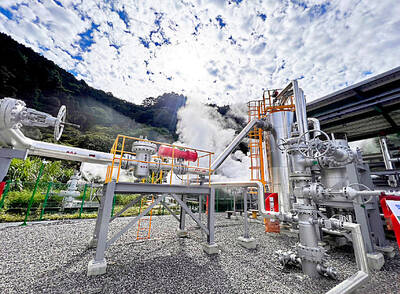
Taiwan’s semiconductor industry consumes electricity at rates that would strain most national grids. Taiwan Semiconductor Manufacturing Co (TSMC) alone accounted for more than 9 percent, or 2,590 megawatts (MW), of the nation’s power demand last year. The factories that produce chips for the world’s phones and servers run around the clock. They cannot tolerate blackouts. Yet Taiwan imports 97 percent of its energy, with liquefied natural gas reserves measured in days. Underground, Taiwan has options. Studies from National Taiwan University estimate recoverable geothermal resources at more than 33,000 MW. Current installed capacity stands below 10 MW. OBSTACLES Despite Taiwan’s significant geothermal potential, the

The entire Li Zhenxiu (李貞秀) saga has been an ugly, complicated mess. Born in China’s Hunan Province, she moved to work in Shenzhen, where she met her future Taiwanese husband. Most accounts have her arriving in Taiwan and marrying somewhere between 1993 and 1999. She built a successful career in Taiwan in the tech industry before founding her own company. She also served in high-ranking positions on various environmentally-focused tech associations. She says she was inspired by the founding of the Taiwan People’s Party (TPP) in 2019 by Ko Wen-je (柯文哲), and began volunteering for the party soon after. Ko

Chinese Nationalist Party (KMT) Chair Cheng Li-wun (鄭麗文) returned from her trip to meet People’s Republic of China (PRC) dictator Xi Jinping (習近平) bearing “a gift” for the people of Taiwan: 10 measures the PRC proposed to “facilitate the peaceful development of cross-strait relations.” “China on Sunday unveiled 10 new incentive measures for Taiwan,” wrote Reuters, wrongly. The PRC’s longstanding habit with Taiwan relations is to repackage already extant or once-existing policies and declare that they are “new.” The list forwarded by Cheng reflects that practice. NEW MEASURES? Note the first item: establishing regular communication mechanisms between the Chinese Communist Party




 RSS
RSS