


This used to be a railroad town with a dozen tracks and a dozen bars and a lot of jobs.
But then the railroad company decided it did not need Caliente anymore. Now, instead of stopping, the freight trains barrel through the middle of town.
Most of the bars are closed, and storefronts on the main street are boarded up, but Mayor Kevin Phillips has figured out a way to lift the fortunes of his struggling hamlet tucked in the mountains about 200km north of Las Vegas. Nuclear waste.
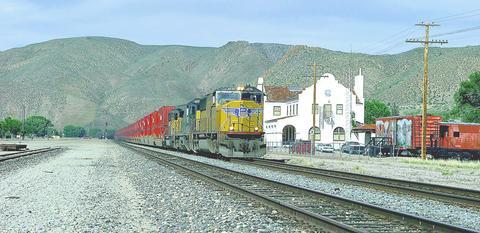
PHOTO: NY TIMES
Phillips, 53, who owns a local hardware store, has volunteered Caliente, population 1,200, to be the transfer station for the nation's spent nuclear fuel that is supposed to be stored in the Yucca Mountain repository beginning in 2010.
Though the repository plan has run into stiff opposition in Nevada, Phillips' idea has supporters, including the federal government, which announced in April that it wanted to run a train through here to carry the waste to its final resting place.
"It would be absolutely safe, with the proper training, and it would bring jobs that we sorely need," said Phillips, who walks around town with a tape measure on his belt. "We rural people don't get all watery-eyed about this kind of thing."
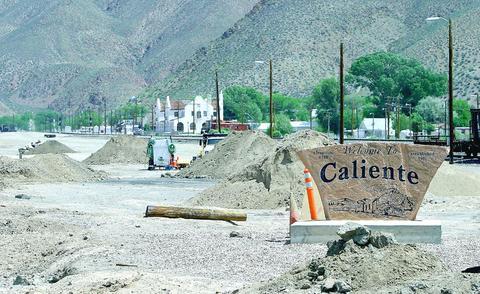
PHOTO: NY TIMES
Phillips, who earns US$190.40 a month as mayor, has become a political lightning rod in the national nuclear waste disposal debate.
Not one major politician in Nevada supports the Yucca Mountain plan, and the "Glow Train" plan, as it is called around here, has split this tiny town down the middle.
Marge Detraz is the mayor's archnemesis, and the person responsible for the "No Nukes" signs on trees and fences around town. Detraz, a 77-year-old widow who offers strangers brownies with nuts, figures she has spent US$125,000 of her own money battling the mayor and the federal government over the train. She and her husband earned that money working at the nuclear test site where the waste is to be stored.
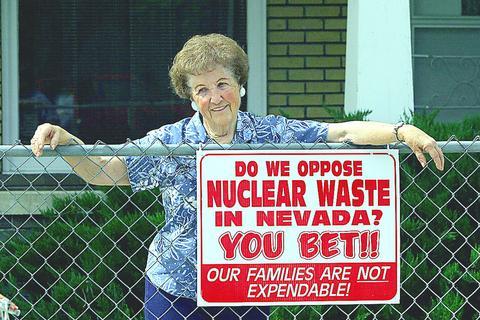
PHOTO: NY TIMES
She is a fixture in the local Mormon church, which Phillips also attends. She considers him a good, spiritual man and compliments him on his skin-tingling oratory. But when it comes to the train, her invective for her neighbor is stinging, referring to him as corrupt, tyrannical and an unwitting tool of forces more powerful than himself.
"If they bring that train in with that nuclear waste, it has the potential to kill all of us," Detraz said. "I mean, the tracks run straight through the middle of town. And the mayor thinks he's going to save Lincoln County with that thing? He's crazy."
Phillips is philosophical about the criticism. "This is no launch pad into senatorial politics, I'll tell you that," he said.
Nukes mean jobs -- maybe 100, maybe 300 -- and Phillips, father of 10, is tired of seeing Caliente children graduate from high school and move down the hill to Las Vegas to find a living. Handled correctly, nuclear waste can be as safe to handle as household garbage, he said.
"What's the picking difference?" asked Phillips. "The government is going to put a rail system in anyway, so why shouldn't we benefit?"
Caliente is on a main line of the Union Pacific Railroad. Dozens of hazardous material shipments come through every day, the mayor said, and there has never been a major accident.
"It's just 50 yards out my front door," he said. "It could take out the whole town, but no one ever complains about that."
The US Department of Energy announced in April that it would prefer to ship nuclear waste to Yucca Mountain by a rail line that would begin in Caliente and wind 500km around the border of the test site and end at the mouth of the repository, about 160km northwest of Las Vegas. The repository would accommodate 77,000 tonnes of radioactive waste from 39 states, none of it from Nevada.
The railroad would cost US$880 million to build, the department estimates, and two loads of nuclear waste stored in casks would run through Caliente each day.
The energy department's announcement is the first significant movement in the debate since US President George W. Bush designated Yucca Mountain as a nuclear waste storage site in 2002, over the objections of Nevada Governor Kenny Guinn. Scientists have questioned whether Yucca Mountain has the structural integrity to hold up for 10,000 years.
Rural Nevadans, libertarian to their marrow, do not trust the federal government, which controls nearly 90 percent of Nevada's territory. It was the government, Detraz pointed out, that said nuclear testing was safe, and so the whole town would come out onto the ridge in the 1950s to watch the above-ground detonations at the Nevada test site with their naked eyes.
People died from mysterious illnesses. Dogs limped around with open sores.
"People back East make the garbage and we got to take it," said Michael Budreau, 38, preparing himself for an afternoon beer since he cannot find work here.
"Nuclear waste will bring money and jobs, that's for sure," Budreau said. And then almost in a whisper, he revealed what he thought the real problem was.
"Jobs will also bring new people, and if anybody around here's talking truthful, they will tell you they don't want them."

It’s only half the size of its more famous counterpart in Taipei, but the Botanical Garden of the National Museum of Nature Science (NMNS, 國立自然科學博物館植物園) is surely one of urban Taiwan’s most inviting green spaces. Covering 4.5 hectares immediately northeast of the government-run museum in Taichung’s North District (北區), the garden features more than 700 plant species, many of which are labeled in Chinese but not in English. Since its establishment in 1999, the site’s managers have done their best to replicate a number of native ecosystems, dividing the site into eight areas. The name of the Coral Atoll Zone might
The US war on Iran has illuminated the deep interdependence of Asia on flows of oil and related items as raw materials that become the basis of modern human civilization. Australians and New Zealanders had a wake up call. The crisis also emphasizes how the Philippines is a swatch of islands linked by jet fuel. These revelations have deep implications for an invasion of Taiwan. Much of the commentary on the Taiwan scenario has looked at the disruptions to world trade, which will be in the trillions. However, the Iran war offers additional specific lessons for a Taiwan scenario. An insightful

On Monday morning, in quick succession, the Chinese Communist Party (CCP) and the Chinese Nationalist Party (KMT) released statements announcing “that the Central Committee of the Communist Party of China and General Secretary Xi Jinping (習近平) have invited KMT Chairwoman Cheng Li-wun (鄭麗文) to lead a delegation on a visit to the mainland” as the KMT’s press release worded it. The KMT’s press release added “Chairwoman Cheng expressed her gratitude for the invitation and has gladly accepted it.” Beijing’s official Xinhua news release described Song Tao (宋濤), head of the Taiwan Work Office of the CCP Central Committee, as

Polling data often confirms what we expect, but sometimes it throws up surprises. When examined over time, some patterns appear that speak to something bigger going on. In this column, whenever possible, Formosa’s polls are used. Despite the sometimes cringeworthy antics of Formosa’s Chairman, Wu Tzu-Chia (吳子嘉), the data produced includes detailed breakdowns crucial for analysis. It has also been conducted monthly 11-12 times a year for many years with many of the same questions, allowing for analysis over time. When big shifts do occur between one month and the next it is usually in response to some event in


 RSS
RSS