


Here's the buzz: At least one competitor used a banned substance at the World Beard and Mustache Championships last month in Carson City, Nevada.
In a sport where Vaseline provides more of an edge than creatine, one top-ranked competitor in the Goatee Natural division was later found to have used mustache wax -- more of a controlling substance than a controlled substance but illegal nonetheless -- to help keep every whisker shiny and in its proper place.
Rather than causing a tousle trying to determine a real winner, first-place trophies were presented to both competitors. (There was no splitting hairs in the Goatee Freestyle, won by Jurg Biland, a butcher from Switzerland.)
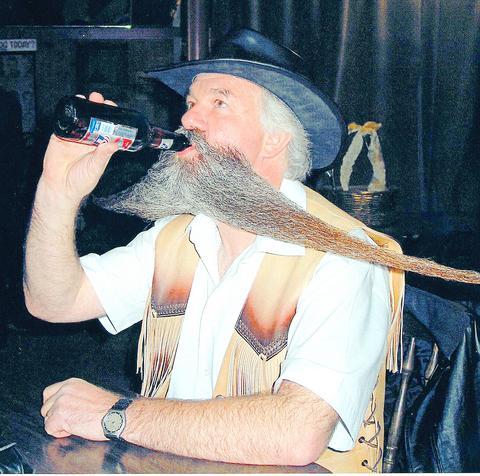
PHOTO: NY TIMES
"We handled it like they did in the Olympics with pairs figure skating," said Phil Olsen, a bearded, 54-year-old lawyer who organized the event. Olsen's side gig helps decide such matters -- he is a settlement conference judge for the Supreme Court of Nevada.
Judges included the mayor of Carson City, Ray Masayko (mustache); the chief justice of the Nevada Supreme Court, Deborah Agosti (no mustache); a Mark Twain impersonator named MacAvoy Layne (beard); Miss Nevada 2003, Christina O'Neil (no beard); and Danny Rotter, the Carson High School senior class vice president (the president, apparently, had other obligations).
Held for the first time in the US -- previous championships were in Norway, Sweden and Germany -- this festival of facial hair featured 123 contestants from nine countries who competed in other categories like Imperial Mustache, Wild West Mustache, Full Beard Freestyle and Sideburns.
Official programs (US$3) included a ballot for spectators to predict champions in each category. The winner received a T-shirt, US$100 and two plane tickets to Berlin, where the next championship will be, in 2005. Guidelines for each category were strict. Rules of the Fu Manchu mustache, for example, read: "Areas other than the upper lip or up to 2cm past the corner of the mouth and downward along the side of the chin must be shaved. Ends long and pointing down."
The overall champion was Karl-Heinz Hille of Germany, 60, representing the Berlin Beard Club and Imperial Mustache wearers everywhere.
Each look was accentuated by a costume that reflected the spirit of the individual style. Hille looked razor-sharp in an 1890s-style silver tuxedo and top hat with white gloves and a cane, and one Wild West hombre rode into town wearing a 10-gallon hat and a six-gun (or was that a hair-dryer?) dangling from his holster.
"Beards can be a sign of great character; think of Abraham Lincoln, Santa Claus and Jesus Christ," said Olsen, who is co-producing a DVD documenting the event with Firelight Films of Tahoe City, California, to be released tomorrow.
"When it comes to sporting mustaches and beards," Olsen said, "Germans are the most competitive."
And so they came. Not just from Germany, but from Switzerland, Britain, Sweden, Norway, Italy and Hong Kong, all fit to be trimmed, their duffel bags filled with the tools of a trade necessary to groom potential champions -- shampoos, conditioners, hair spray, hair pins, gels, foams, combs, tonics, brushes, curlers (curlers?), picks, razors, scissors, rubber bands, shaving cream, compact mirrors and, yes, mustache wax.
That morning, some of the biggest names in bearding marched past 40,000 spectators at the annual Nevada Day parade. Among them was Ted Sedman, president of London's Handlebar Club, who took first place in the Fu Manchu category.
Contestants from the host country included Bruce Roe, the first American to win a trophy at these championships, as well as the six-time beard champion of the Iowa State Fair, Gary James Chilton.
Chilton, 60-something, took it on the chin-whiskers in Carson City, finishing fourth in the Full Beard Natural division. While his 1.04m salt-and-pepper beard hid his kneecaps, nothing could hide his displeasure.
"Yes, I was disappointed," said Chilton, a celebrity in his hometown of Sioux City, Iowa. "I didn't wear a costume, and that probably hurt me. But just based on sheer length, I should have won at least third place."
Chilton, whose beard recently celebrated its 26th birthday (that's how long it has gone unshaven), describes a man with a beard as "open-minded, nonjudgmental and a free spirit."
He describes a clean-shaven man as "someone who has been told what to do." He added, "The kind of man who walks around and says, `No, my wife wouldn't like that.'"
And a man with a mustache?
"Well, that's more of a compromise," Chilton said. "The wife wouldn't allow a full beard, but a mustache? Well, OK, honey."

“Taiwan’s Opposition Leader Comes to US With a Message Straight Out of Beijing” read a May 31 headline in the Wall Street Journal. Top US administration officials and members of Congress almost certainly read the WSJ, and if there was a bullet point takeaway that people in Washington should absorb ahead of Chinese Nationalist Party (KMT) Chair Cheng Li-wun’s (鄭麗文) arrival in DC on June 9, that headline is it. The last few columns have discussed this very topic, and the timing is not coincidental. While those top officials likely do not read the Taipei Times, judging by the number

With weighty, anxiety-inducing geopolitical topics dominating the headlines, checking in on the wild and weird state of local politics can take some of the edge off. This November’s elections will determine who will be in charge of fixing potholes in your neighborhood, not the potholes in Taiwan’s complicated geopolitical space. Recently, after an online interview with a Taipei-based journalist, I commented that Taipei journalists never go further than the MRT can take them. He laughed and agreed. Naturally, the Taipei mayoral race is eating up much of the press attention. TAIPEI CITY Democratic Progressive Party (DPP) candidate Puma Shen (沈伯洋) has
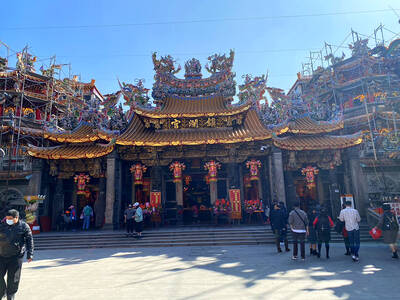
In December of 2008 Lee E-tin (李乙廷), a Miaoli county legislative hopeful, was convicted of vote-buying. Rather than buy votes retail, voter by voter, in the usual manner, Lee had done it wholesale, in a commendably efficient manner: he had visited local temples and made donations to gain their support. Because he did not normally make donations to temples, the court ruled he was attempting to improperly influence voter behavior. The case indicates how important temples are in influencing political life. Both judge and politician appeared to see them in the same way. Beijing sees them that way as well. Democratic Progressive
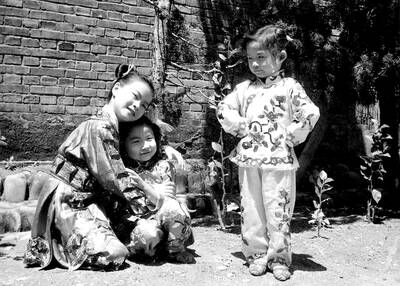
Audiences in Leicester, Cardiff, London and Sheffield will this month gather to watch a series of black-and-white Taiwanese-language films made more than 70 years ago. On the surface, these screenings commemorate the seventieth anniversary of taiyupian (台語片) — Taiwanese-language cinema. Yet the significance of these events extends far beyond nostalgia or film history. They represent a remarkable chapter in Taiwan’s ongoing effort to recover, preserve and reinterpret a cultural heritage that was once thought to have largely disappeared. The centerpiece of the program is the Ho Chi-ming (何基明) directed Xue Pinggui and Wang Baochuan (薛平貴與王寶釧), a film produced in 1955 and


 RSS
RSS