


Lee Meng-hsian (
Lee is running to keep pace with a fitness craze that is one of the strongest recent trends to grip Taiwan and Asia. In the past three years, two of the largest fitness franchises in the US have set up shop in Taiwan and dozens of imitators have followed suit. All of them have been proselytizing the benefits of physical fitness; a lesson which hasn't been lost on a traditionally very health-conscious population.
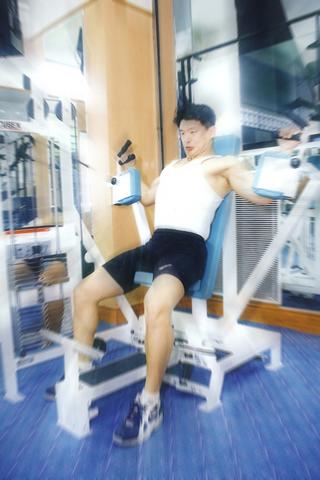
PHOTO: TAIPEI TIMES FILE PHOTO
Of course exercise is nothing new to Taiwan. Small groups have long gathered in the early mornings in most every park on the island to practice tai chi, or else wave their arms around as if they were doing so. But this isn't tai chi in the park nor the arm-waving and limb-slapping exercises fancied by elderly Taiwanese. The fitness fever that has infected the nation is about more than keeping healthy. For the twentysomething disciples of the body beautiful, exercise borders on religious devotion.
"I come every other day directly after work and once or twice on the weekend, depending on whether I worked out three times during the week or four," Lee says over the frenetic beat of a Leon Lai (
Lee is exactly the kind of member sought after by Taiwan's rapidly expanding number of health clubs. Five years out of college and already only a few rungs from the top of the advertising company for which he works, he walked into the Hsimenting branch of California Fitness of his own accord and within 40 minutes signed away tens of thousands of NT dollars. He's since convinced three friends to join.
"You walk past the place and all this energy comes out. They don't hardly need advertising, they have word-of mouth ... and posters of Pamela Anderson." Of the foreign-owned clubs that have entered the local market, California Fitness has made the biggest splash, with three branches in Taipei City and another planned for Taichung.
Golds, perhaps the most recognizable name in the health club industry, also has a branch in Taipei City and is actively looking for a suitable location for a second branch. "We hope eventually to open two more branches in the Taipei area, but for now we're looking at properties near MRT stations," says Linda Chao (
Independent newcomer Hollywood is nearing completion of a 1,100-ping (3,600 ㎡) facility with an outdoor pool in Tienmu which is scheduled to open in April. And Alexander Health Clubs (亞力山大俱樂部), which has long enjoyed a near monopoly in Taiwan, operates 22 branches and reports a membership of 160,000. Faced with the recent competition, the company has slowed its previous rate of expansion from eight branches per year to two, but is also expanding into the China market.
As waistlines grow thinner, so do wallets. The average cost for a one-year membership to one of these clubs is around NT$20,000. Ironically, for people like Lee, the hefty admission price has associated benefits.
"When you pay the membership fee you really become committed to coming. If I only come once a week each of those visits costs a lot more than they do if I come four or five times a week," says Lee, setting financial as well as physical benchmarks.
His friend, Andrew Chou, is more nonchalant. "You spend the money, you come here and run and lift weights or do aerobics or whatever and you feel better. It's an investment." Or is it?
Asked which came first; fitness centers or the fitness craze, most of the people interviewed for this article said fitness centers. Few people claimed to exercise at all before joining their current health club. Lee could only cite his military training and Chou the occasional game of basketball. It's as if health clubs invented the idea of being healthy.
But reminded that they could get an equivalent -- and much less expensive -- workout by rearranging their furniture every night, Lee and Chou remain convinced of the benefits of membership.
Standing beside the glass wall of an aerobics studio, they glance over their shoulders at the class in progress. Two dozen or more people, mostly young women, stand doubled over with their butts in the air. "Yeah well," Chou says. His voice trails off but his point is made.
So, the benefit to joining a health club -- besides watching yourself get in great shape -- is watching what great shape others are already in. The health clubs, for their part, always take this basic instinct into consideration, even if they handle it in different ways.
All California Fitness centers are outfitted with glass walls, making it easy for people outside to see in and those inside to peer in on the action in the studios. By contrast, Golds partitioned off one whole floor of their facility over a year ago and reserved it for women only. Other clubs market themselves to the gay community. But for all the glass walls and Spandex pants, and despite all the leering eyes and double-takes, no one is talking about sex.
"This is my ritual," says Janni Hsu. "Leaving work, coming to the gym, changing into sweats ... it can change my frame of mind, too. My face always turns red when I sweat, but I don't care anymore."
And how does she feel about glass walls and leering eyes. "Well ... the classes are almost all girls and the guys just stand around the weight machines. Nobody talks to anybody unless they know them. I think most people join just to get in shape."

“Taiwan’s Opposition Leader Comes to US With a Message Straight Out of Beijing” read a May 31 headline in the Wall Street Journal. Top US administration officials and members of Congress almost certainly read the WSJ, and if there was a bullet point takeaway that people in Washington should absorb ahead of Chinese Nationalist Party (KMT) Chair Cheng Li-wun’s (鄭麗文) arrival in DC on June 9, that headline is it. The last few columns have discussed this very topic, and the timing is not coincidental. While those top officials likely do not read the Taipei Times, judging by the number

With weighty, anxiety-inducing geopolitical topics dominating the headlines, checking in on the wild and weird state of local politics can take some of the edge off. This November’s elections will determine who will be in charge of fixing potholes in your neighborhood, not the potholes in Taiwan’s complicated geopolitical space. Recently, after an online interview with a Taipei-based journalist, I commented that Taipei journalists never go further than the MRT can take them. He laughed and agreed. Naturally, the Taipei mayoral race is eating up much of the press attention. TAIPEI CITY Democratic Progressive Party (DPP) candidate Puma Shen (沈伯洋) has
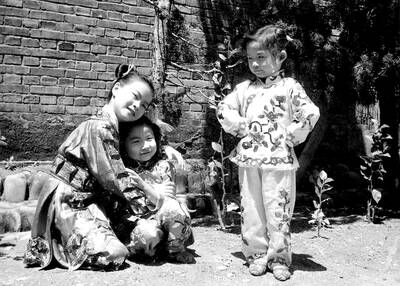
Audiences in Leicester, Cardiff, London and Sheffield will this month gather to watch a series of black-and-white Taiwanese-language films made more than 70 years ago. On the surface, these screenings commemorate the seventieth anniversary of taiyupian (台語片) — Taiwanese-language cinema. Yet the significance of these events extends far beyond nostalgia or film history. They represent a remarkable chapter in Taiwan’s ongoing effort to recover, preserve and reinterpret a cultural heritage that was once thought to have largely disappeared. The centerpiece of the program is the Ho Chi-ming (何基明) directed Xue Pinggui and Wang Baochuan (薛平貴與王寶釧), a film produced in 1955 and
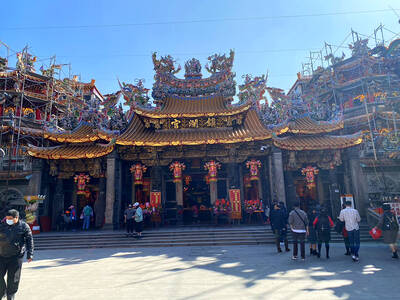
In December of 2008 Lee E-tin (李乙廷), a Miaoli county legislative hopeful, was convicted of vote-buying. Rather than buy votes retail, voter by voter, in the usual manner, Lee had done it wholesale, in a commendably efficient manner: he had visited local temples and made donations to gain their support. Because he did not normally make donations to temples, the court ruled he was attempting to improperly influence voter behavior. The case indicates how important temples are in influencing political life. Both judge and politician appeared to see them in the same way. Beijing sees them that way as well. Democratic Progressive


 RSS
RSS