


It takes strength and resolution to destroy oneself and begin again from scratch. But Lin Chung (林
"I used to write songs with my guitar. Now I use this," Lin said, pointing to a digital synthesizer and sequencer in his Shinlin studio.

"The future of music is less about song, less about melody. The feeling, the atmosphere will be more important. Sometimes people just need a wave of sound," Lin said.
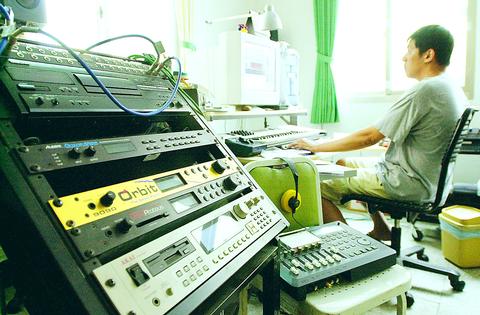
PHOTO: GEORGE TSORNG, TAIPEI TIMES
Now 38 but still baby-faced, Lin lives in his small studio, as he prepares to release his new album, the first Taiwanese-language electronic music album.
Right beginnings
Ten years ago Lin was a household name, with his music videos seeing constant rotation on TV and his 1989 song Marching Forward (向
In the video Lin sings "Ohh' Go ahead!/Oh' I fear nothing/in such a big city like Taipei/I'm gonna make something to return home with pride" while moving to its disco beat along with his corps of dancers.
Singing rock 'n' roll in Taiwanese without any trace of self-consciousness was rare at a time when the only Taiwanese-language pop songs one heard were by Nakashi-influenced crooners singing pained love songs. Lin's rock was refreshing and exciting both for the pop music scene and for society as a whole, which had just been freed from martial law, during which the Taiwanese language was marginalized. Marching Forward was practically a theme song for the political movements occurring at the time.
Politicians, hoping to boost their street credibility during the nascent so-called political "localization" drive, appropriated the song as an embodiment of the Taiwanese spirit. Lin Chung then went from being a pop star to a symbol for an entire social transformation.
"Three years ago, some KMT politician even offered me NT$400,000 to sing Marching Forward for an election campaign rally," Lin said. He rejected the offer, refusing to be drawn back to that part of his past.
After the success of Marching Forward, Lin released a hot-selling album titled Spring Young Fellow (春
It was about this time that fame began to wear on Lin and he began searching for an exit from the media's incessant gaze. Then he became close friends with the acclaimed Taiwanese film director Hou Hsiao-hsien (
"Director Hou by chance went to see Lin at a recording studio. And he was truly impressed by Lin's strength and devotion to singing. He thinks Lin has a quality of typical Taiwanese men -- truly sincere and focused on what they like to do. And that was the kind of person Hou was looking for to play the protagonist in the movie Puppet Master (
"Director Hou had a great deal of influence on Lin Chung, good and bad. The bad part was Lin later walked away from the mainstream pop music scene and his idol image to become the media's favorite bad boy. The good was that Lin became quieter, like director Hou, who tries to focus on his own art," said Jessie Huang (
In 1993, when Lin published his third album Entertainment World, which was produced by John Fryer, the producer for Nine Inch Nails, he rejected all interviews and refused to be part of any TV or radio show. Then, at the Golden Horse Award ceremony in 1996, Lin received the Best Film Music award for the song Self Destruction and when accepting the award, he took the trophy and swiftly left in silence, leaving his PR staff and the media in shock.
Finding his way again
"At that time, I felt I was labeled and limited to the role I had to play. I had lost my freedom," said Lin.
Lin retreated further from the media spotlight and went on to star in several of Hou's films, such as Good Man, Good Woman (
Eight years after Entertainment World, Lin is poised to come back with his latest creation. His new single A Simple Person (單純的人) was chosen as the theme song for Hou Hsiao-hsien's latest movie Millennium Mambo (千禧曼波).
In the film's opening scene, the starlet Shu Qi (
"I'm no longer a star singer anymore. So my vocal singing is just one of the musical instruments I mix with the music," Lin said. As for the lyrics in Taiwanese, he says plainly "It's my mother tongue. I feel weird and unnatural if I have to sing in Mandarin."
Lin's new album, due out at the end of this month, is filled with a variety of styles that covers the full range of electronic music. Along with A Simple Person, other tracks include the trip hop-flavored Fallen (沉淪), the ambient The World (世間) and a techno track called Drugs not for Illness (無病吃的藥).
"He is by nature a kind and simple person. Lin used to be unhappy, and now he is much more relaxed," said a local filmmaker who goes simply by the name Orange (
Lin now lives a healthy, regular life, getting up at 6am, riding his bicycle to the Tamsui riverbank where he does two hours of tai-chi, and then heading to work on his music at his Shihlin studio called Fluidmix (
"In the mornings [after moving recently to Shihlin], I would always pass a group of old ladies chatting in the streets. I saw people could be really happy with a simple and ordinary life," Lin said.
To friends like Angelika Wang and Orange, his ability to change and to try new things are Lin's greatest attributes. "What I appreciate the most about Lin is his ability to negate himself and then move forward to a new challenge," Wang said.
"He knows when to stop and to change directions. He is always blossoming," Orange said.
Reflecting on the adaptability that his friends so admire, Lin says philosophically "You have to keep moving, flowing, and not take everything so hard. But never stop, because once you're stuck in one place, you're dead."

In late October of 1873 the government of Japan decided against sending a military expedition to Korea to force that nation to open trade relations. Across the government supporters of the expedition resigned immediately. The spectacle of revolt by disaffected samurai began to loom over Japanese politics. In January of 1874 disaffected samurai attacked a senior minister in Tokyo. A month later, a group of pro-Korea expedition and anti-foreign elements from Saga prefecture in Kyushu revolted, driven in part by high food prices stemming from poor harvests. Their leader, according to Edward Drea’s classic Japan’s Imperial Army, was a samurai

The following three paragraphs are just some of what the local Chinese-language press is reporting on breathlessly and following every twist and turn with the eagerness of a soap opera fan. For many English-language readers, it probably comes across as incomprehensibly opaque, so bear with me briefly dear reader: To the surprise of many, former pop singer and Democratic Progressive Party (DPP) ex-lawmaker Yu Tien (余天) of the Taiwan Normal Country Promotion Association (TNCPA) at the last minute dropped out of the running for committee chair of the DPP’s New Taipei City chapter, paving the way for DPP legislator Su

It’s hard to know where to begin with Mark Tovell’s Taiwan: Roads Above the Clouds. Having published a travelogue myself, as well as having contributed to several guidebooks, at first glance Tovell’s book appears to inhabit a middle ground — the kind of hard-to-sell nowheresville publishers detest. Leaf through the pages and you’ll find them suffuse with the purple prose best associated with travel literature: “When the sun is low on a warm, clear morning, and with the heat already rising, we stand at the riverside bike path leading south from Sanxia’s old cobble streets.” Hardly the stuff of your

Located down a sideroad in old Wanhua District (萬華區), Waley Art (水谷藝術) has an established reputation for curating some of the more provocative indie art exhibitions in Taipei. And this month is no exception. Beyond the innocuous facade of a shophouse, the full three stories of the gallery space (including the basement) have been taken over by photographs, installation videos and abstract images courtesy of two creatives who hail from the opposite ends of the earth, Taiwan’s Hsu Yi-ting (許懿婷) and Germany’s Benjamin Janzen. “In 2019, I had an art residency in Europe,” Hsu says. “I met Benjamin in the lobby


 RSS
RSS