


Who is President Chen Shui-bian's (
Political observers think that with PFP Chairman James Soong (
"The current Taipei mayoral election campaign shows that Ma's strategy is to be respectful to Lee Teng-hui (李登輝), criticize Chen and ignore [DPP mayoral candidate] Lee Ying-yuan (李應元)," senior political observer Hu Wen-hui (胡文輝) said.
"And for the sake of retaking the capital for the DPP, President Chen joined the campaign earlier than scheduled and launched fierce attacks on Ma during his stumps for the DPP's Lee. This has made an impression of the duel between Ma and A-bian on the electorate," Hu said.
"Once the Bian-Ma duel becomes the mainstream discourse in the media, people will pin their hopes for national leadership on these two political stars and thereby push for a generational change in Taiwan's political parties. Fifty-something politicians will dominate the political stage, while those over 60 will have to step down or play a role behind the scenes," Hu said.
Hu pointed out that the political trends are quite clear -- within the KMT, the party is focusing more on Ma.
As Lien Chan has proved to be an unattractive product in the electoral market and the party's reforms have gone nowhere over the past two years, the KMT's future is solely dependent on Ma. Hence, the party elite and members under 50 have been cozying up to him.
"Party elders know all too well that they won't be able to win the next presidential election with chairman Lien Chan alone. Cooperation with James Soong would mean the annexation of the party by the PFP," Hu said. "And party leaders such as Wu Po-hsiung (
Chin Heng-wei (
"The fact that pan-blue politicians have jumped on Ma's bandwagon one after the other forced Soong to take the stage early, raising his voice in lashing out at President Chen, lest he should be eliminated in this round of political competition in the media," Chin said.
Chin added that Soong's recent passionate comments were an indication of his anxiety. Soong's public statement of being "willing to drop the bid for the presidency if President Chen honestly faces the `one China' question" is equivalent to a declaration of his presidential bid. Soong even resorted to personal attacks against the president on several occasions in order to boost his media exposure.
"Chen, commanding the strategic position as the president, could change his target at will. He can alternately attack Ma and Soong, has the control over initiatives and can sow discord in the pan-blue camp," Chin said.
"What worries Soong is that once his competitor in the pan-blue camp changes from Lien to Ma, his chances become slimmer," Chin added.
The key lies in Lien's inclination and the resistance of some senior party staff and close aides of Lien.
According to Chin, if Lien recognizes the fact that he stands no chance of winning and works with grassroots party members, Ma could become the pan-blue camp's presidential candidate.
Soong wouldn't be able to do anything to combat this move and would have no choice but to retreat from the frontline.
According to Lin Dong-tai (
This shows the level of discontent with the delay in party reforms within the KMT, Lin said.
"The KMT has a long tradition of respecting seniority and the consequence has been that the party is always in the hands of elders, making reforms difficult.
"Now, with the slogan justifying `subversion,' some KMT members obviously hope to cultivate and nurture an atmosphere of anti-seniority. It merits further observation whether this trend will gain steam after Ma wins his re-election," Lin said.
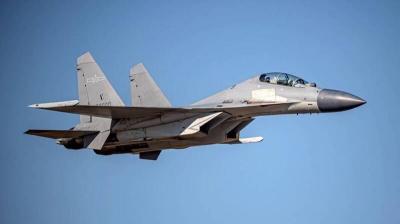
Eight Chinese naval vessels and 24 military aircraft were detected crossing the median line of the Taiwan Strait between 6am yesterday and 6am today, the Ministry of National Defense said this morning. The aircraft entered Taiwan’s northern, central, southwestern and eastern air defense identification zones, the ministry said. The armed forces responded with mission aircraft, naval vessels and shore-based missile systems to closely monitor the situation, it added. Eight naval vessels, one official ship and 36 aircraft sorties were spotted in total, the ministry said.
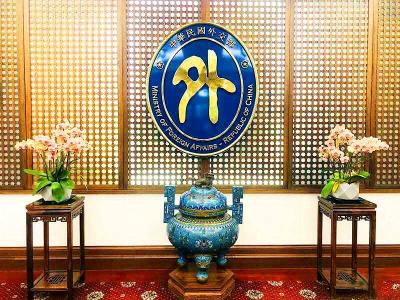
The Ministry of Foreign Affairs (MOFA) today said that if South Korea does not reply appropriately to its request to correct Taiwan’s name on its e-Arrival card system before March 31, it would take corresponding measures to alter how South Korea is labeled on the online Taiwan Arrival Card system. South Korea’s e-Arrival card system lists Taiwan as “China (Taiwan)” in the “point of departure” and “next destination” fields. The ministry said that it changed the nationality for South Koreans on Taiwan’s Alien Resident Certificates from “Korea” to “South Korea” on March 1, in a gesture of goodwill and based on the
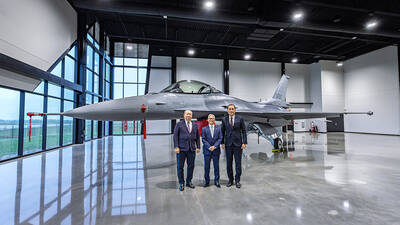
Taiwanese officials were shown the first of 66 F-16V fighter jets purchased by Taiwan from the United States, the Ministry of National Defense said yesterday, adding the aircraft has completed an initial flight test and is expected to be delivered later this year. A delegation led by Deputy Minister of National Defense Hsu Szu-chien (徐斯儉) visited Lockheed Martin’s F-16 C/D Block 70 (also known as F-16V) assembly line in South Carolina on March 16 to view the aircraft. The jet will undergo a final acceptance flight in the US before being delivered to Taiwan, the
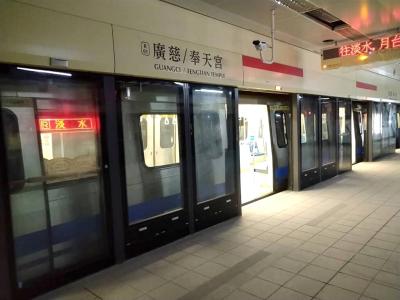
The New Taipei Metro's Sanyin Line and the eastern extension of the Taipei Metro's Tamsui-Xinyi Line (Red Line) are scheduled to begin operations in June, the National Development Council said today. The Red Line, which terminates at Xiangshan Station, would be connected by the 1.4km extension to a new eastern terminal, Guangci/Fengtian Temple Station, while the Sanyin Line would link New Taipei City's Tucheng and Yingge stations via Sanxia District (三峽). The council gave the updates at a council meeting reviewing progress on public construction projects for this year. Taiwan's annual public infrastructure budget would remain at NT$800 billion (US$25.08 billion), with NT$97.3


 RSS
RSS