


Deutsche Bank AG, Germany’s biggest lender, yesterday reported a slump in profits in the first quarter, with new CEO Christian Sewing announcing deep cuts at its flagship corporate and investment banking division to tackle its woes.
Net profit at the Frankfurt-based group fell 79 percent year-on-year to 120 million euros (US$146 million).
Pre-tax profit fell 51 percent to 432 million euros, as sales dropped 5 percent to 7 billion euros.

Photo: AP
“We have to act decisively and to adjust our strategy. There is no time to lose as the current returns for our shareholders are not acceptable,” Sewing said in a statement.
A Deutsche Bank lifer, Sewing was promoted this month to replace crisis-fighting CEO John Cryan.
The British boss extricated the bank from its painful legal hangovers from the financial crisis, but failed to steer it back to profitability over years of restructuring, reporting three annual losses in a row.
With much of the pain centered on the corporate and investment bank, the flagship division — which accounted for more than half of Deutsche’s revenue in the first quarter — is first in line for reform.
In a separate statement, the group said the unit would “focus its activities and resources on its European and multinational clients and the products which are most relevant for them, while reducing its exposure to other areas.”
In corporate finance, it plans more engagement in Europe while slashing its commitment to the US and Asia, saying it would address clients “whose activities are closely aligned with the strengths of the German and European economies.”
Deutsche will also retreat from some trading in bonds and other financial market products in the US to pursue the “more attractive returns” on offer in Europe.
Moreover, it will likely reduce the size of its stocks trading business following a review.
Sewing said there would be “painful, but regrettably unavoidable” cuts in staff numbers “to ensure our bank’s competitiveness in the long run.”

Netherlands-based semiconductor equipment supplier ASML Holding NV yesterday said that it is planning to hire an additional 1,000 people in Taiwan this year in response to growing demand from clients. ASML had previously planned to recruit 600 people this year, but that the plan has been adjusted upward, ASML vice president and ASML Taiwan general manager Grace Wang (汪佳慧) told reporters. ASML has a workforce of more than 4,500 in Taiwan, accounting for about 10 percent of its global total, Wang said. This year’s recruitment campaign would focus on adding people in the customer support, manufacturing and supply chain domains to assist ASML
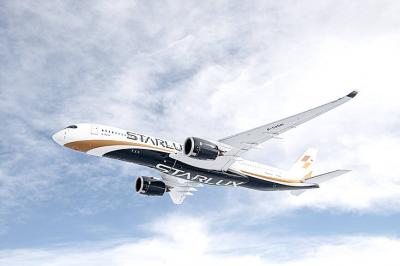
Starlux Airlines Co (星宇航空) today unveiled a long-haul network expansion plan at a shareholders’ meeting in Taipei, including direct flights to Barcelona, Spain, and Zurich, Switzerland, as well as a service connecting Taipei, Sydney and New Zealand. Starlux is to become the first Taiwanese carrier to offer non-stop services to the two European cities, while the inaugural oceanic route is expected to expand transit opportunities within the Australia-New Zealand market, Starlux said. Flight services to Chicago, Dallas, Washington and New York are under evaluation, the airline added. Prior to the shareholders’ meeting, the airline earlier this year announced that it would be

UNDER MICROSCOPE: Taiwan detained three people who allegedly conspired to buy servers in Taiwan and export them using fraudulent documentation, prosecutors said Nvidia Corp chief executive officer Jensen Huang (黃仁勳) on Saturday urged Super Micro Computer Inc to tighten up on compliance after Taiwan detained three people this week for allegedly making fraudulent declarations about artificial intelligence (AI) servers made by its US partner. The development marked the nation’s first crackdown on semiconductor smuggling, which grew after the US slapped restrictions on exports of high-end chips such as Nvidia AI accelerators to China. Nvidia is “rigorous” in explaining regulations to all of its partners, Huang told reporters after arriving in Taipei. “Ultimately Super Micro has to run their own company,” he said in response to

Nvidia Corp yesterday announced that CEO Jensen Huang (黃仁勳) would attend an employee meeting in Taipei tomorrow to celebrate the launch of the company’s Taiwan headquarters project. Huang would attend a gathering at the site of Nvidia’s planned headquarters in Beitou Shilin Technology Park (北投士林科技園區), the company said in a statement. After arriving in Taiwan on Saturday last week, Huang told reporters that he plans to meet with Quanta Computer Inc (廣達) chairman Barry Lam (林百里) and Taiwan Semiconductor Manufacturing Co (TSMC, 台積電) chairman C.C. Wei (魏哲家), and would attend the groundbreaking ceremony for Nvidia’s Taiwan headquarters tomorrow. Nvidia has not yet applied


 RSS
RSS