


Yong Kang 15 (永康15), the new mango shaved ice shop set up on site of the famed Ice Monster (冰館) on Yong Kang Street, has achieved its revenue target of NT$100,000 (US$3,000) per day less than a week after its official opening on Monday.
The Taipei-based FnB Gourmet Group, the owner of Yong Kang 15, yesterday opened its central kitchen for the shaved ice shop to the media for the first time and said it was not worried that its seemingly overpriced desserts would scare away customers.
“We believe in the principle of market supply and demand. If our products are really too expensive, we would naturally be phased out,” FnB Gourmet marketing director David Hsu (許立) said.

PHOTO: LIN CHENG-KUNG, TAIPEI TIMES
Trying to differentiate Yong Kang 15 from its predecessor, Hsu said that the company had put a lot of effort into developing new recipes for its various shaved ice items to attract more dessert lovers from home and abroad. Ice Monster, which closed down about half a year ago over an ownership dispute, was well-known for its mango shaved ice desserts for 15 years and was included in the New York Times list of 13 things to do in Taipei if you have 36 hours.
While praising the ice shop for its fresh fruit, some customers said the mango serving seemed to be smaller and they couldn’t feel much of a difference in taste and flavor compared with the previous shop.
“The fruit is very fresh and they use mango dressing instead of sugar water, which I find pretty tasty. But I feel like the mango serving, in particular, has become smaller,” a customer named Tina Chou (周經婷) said.
Asked whether it was worth the NT$160 price tag, Chou said it was a bit pricey and that NT$120 would be more reasonable.
The reopening of the shop has also brought back more business to the neighborhood. A taro shaved ice shop next to Yong Kang 15 said it saw more customers come back these days.
“Our shop is less popular with foreign tourists, but we have indeed benefited from [Yong Kang 15’s] reopening and many of our old customers have also come back,” taro ice shop owner Li Yen-han (李彥漢) said.
FnB Gourmet said it was in talks with the National Palace Museum to open a store or kiosk at the museum to promote Taiwanese traditional shaved ice desserts to foreign tourists.
“By the end of this year, we hope to offer online ordering and home-delivery services to meet greater market demand and expand our retail businesses to hotels or department stores,” Hsu said.


Taiwan’s foreign exchange reserves fell below the US$600 billion mark at the end of last month, with the central bank reporting a total of US$596.89 billion — a decline of US$8.6 billion from February — ending a three-month streak of increases. The central bank attributed the drop to a combination of factors such as outflows by foreign institutional investors, currency fluctuations and its own market interventions. “The large-scale outflows disrupted the balance of supply and demand in the foreign exchange market, prompting the central bank to intervene repeatedly by selling US dollars to stabilize the local currency,” Department of Foreign

Intel Corp is joining Elon Musk’s long-shot effort to develop semiconductors for Tesla Inc, Space Exploration Technologies Corp and xAI, marking a surprising twist in the chipmaker’s comeback bid. Intel would help the Terafab project “refactor” the technology in a chip factory, the company said on Tuesday in a post on X, Musk’s social media platform. That is a stage in the development process that typically helps make chips more powerful or reliable. The chipmaker’s shares jumped 4.2 percent to US$52.91 in New York trading on Tuesday. The Terafab project is a grand plan by Musk to eventually manufacture his own chips for
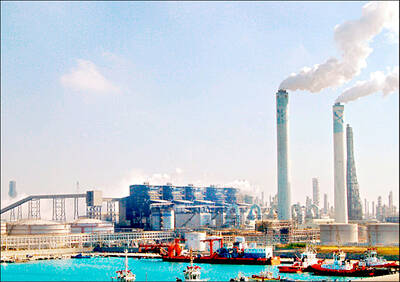
Taiwan Power Co (Taipower, 台電) yesterday said it plans to resume operations at two coal-fired power generators for three months to boost security of electricity supply as liquefied natural gas (LNG) supply risks are running high due to the Middle East conflict. The two coal-fired power generators are at Mailiao Power Plant in Yunlin County’s Mailiao Township (麥寮). The plant, operated by Formosa Plastics Group (台塑集團), supplied electricity to Taipower’s power grid until the end of last year. Taipower’s decision came about one month after Minister of Economic Affairs Kung Ming-hsin (龔明鑫) on March 10 said that the nation had no imminent

Some robotaxi passengers were left stranded in the middle of fast-moving traffic in a major Chinese city after their driverless vehicles stopped running, according to police and media reports on Wednesday. A preliminary investigation indicates more than 100 robotaxis came to a halt because of a “system malfunction,” police in the city of Wuhan said in a statement, without elaborating. No injuries were reported. One passenger told Chinese media that their robotaxi stopped after turning a corner. An instruction on a screen read: “Driving system malfunction. Staff are expected to arrive in 5 minutes.” After no one showed up, the passenger pushed


 RSS
RSS