


Sony Computer Entertainment Asia yesterday announced that a Taiwanese vendor will partly develop a game for its popular PlayStation 3 (PS3).
Sony joined hands with software developer Actainment Co (
"The game is still under development and we expect gamers will see it sometime this summer," said Tetsuhiko Yasuda, the managing director of Sony Computer Entertainment Asia, at a press conference in Taipei yesterday.

PHOTO: CNA
He made the remarks at a signing ceremony with Actainment as well as Japan's Ongakukan Co, the main developer of the game.
Sony said the new game will be launched simultaneously in Taiwan, Hong Kong and Singapore.
"We may talk to other Taiwanese developers for future collaborations on PS3, but no discussions are currently underway," Yasuda said.
"Railfan" offers players a train operating simulation enhanced by the actual scenery of the trip captured by high-definition cameras.
There is also information on major tourist destinations as you pass them.
Ongakukan, which has produced over 30 simulated games modeled on Japanese and US high speed trains, will provide the technology for the game, while Actainment will assist in creating the user interface and the trains.
"Taiwanese developers have unique content, but they are still struggling to hit the world stage," said Malo Haung (
Through collaboration with Japanese firms, the Actainment staff learned game development as well as technological skills.
While only one local vendor has been asked to develop a PS3 game, more than a dozen Taiwanese game developers have been asked by Microsoft Corp to create games for the Xbox 360.
Some of the companies include XPEC Entertainment Inc (樂陞科技), FunTown (和信超媒體戲谷), Soft-World International Corp (智冠科技) and Softstar Entertainment Inc (大宇資訊).

Apple Inc increased iPhone production in India by about 53 percent last year and now makes a quarter of its marquee devices there, reflecting the US company’s efforts to avoid tariffs on China. The company assembled about 55 million iPhones in India last year, up from 36 million a year earlier, people familiar with the matter said, asking not to be named because the numbers aren’t public. Apple makes about 220 million to 230 million iPhones a year globally, with India’s share of the total increasing rapidly. Apple has accelerated its expansion in the world’s most populous country in recent years, bolstered

HEADWINDS: The company said it expects its computer business, as well as consumer electronics and communications segments to see revenue declines due to seasonality Pegatron Corp (和碩) yesterday said it aims to grow its artificial intelligence (AI) server revenue more than 10-fold this year from last year, driven by orders from neocloud solutions clients and large cloud service providers. The electronics manufacturing service provider said AI server revenue growth would be driven primarily by the Nvidia Corp GB300 server platform. Server shipments are expected to increase each quarter this year, with the second half likely to outperform the first half, it said. The AI server market is expected to broaden this year as more inference applications emerge, which would drive demand for system-on-chip, application-specific integrated circuits

Taiwan Semiconductor Manufacturing Co’s (TSMC, 台積電) share of the global foundry market rose to almost 70 percent last year amid booming demand for artificial intelligence (AI), market information advisory firm TrendForce Corp (集邦科技) said on Thursday. The contract chipmaker posted US$122.54 billion in revenue, up 36.1 percent from a year earlier, accounting for 69.9 percent of the global market, TrendForce said. Its share was up from 64.4 percent in 2024, it said. TSMC’s closest rival, Samsung Electronics, was a distant second, posting US$12.63 billion in sales, down 3.9 percent from a year earlier, for a 7.2 percent share of the global market. In the
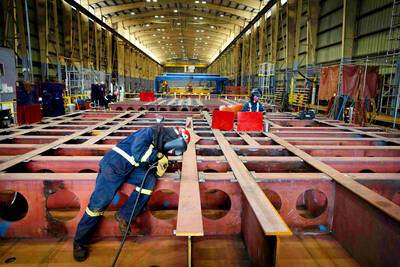
At a massive shipyard in North Vancouver, Canadian workers grind metal beams for a powerful new icebreaker crucial to cementing the country’s presence in the increasingly contested arctic. Icebreakers are specialized, expensive vessels able to navigate in the frozen far north. And “this is the crown jewel,” said Eddie Schehr, vice president of production at the Seaspan shipyard. For Canadian Prime Minister Mark Carney, who heads to Norway next Friday to observe arctic defense drills involving troops from 14 NATO states, Canada’s extreme north has emerged as a strategic priority. “Canada is and forever will be an Arctic nation,” he said ahead of


 RSS
RSS