


Hospitals saw revenues drop by over 50 percent last month after SARS clusters in several facilities kept all but the bravest people away from doctor appointments.
"In addition to over 50 percent revenue losses in May, National Taiwan University Hospital has spent over NT$100 million treating more than 200 SARS patients," hospital Vice Superintendent Hsu Su-ming (
Clinic visits at the facility plummeted after the outbreak of SARS in late April.
National Taiwan University Hospital -- the nation's leading hospital in treating SARS victims -- on average, saw only 2,000 to 3,000 patients a day last month -- down from 7,000 patients per day before the virus outbreak, Hsu said.
Its revenue losses are estimated to be in the hundred of millions of NT dollars after it took in the nation's first SARS patient in mid-March.
Hsu, however, said that after the nation began to contain SARS this month, the hospital began to see more people coming for treatment and now has about 4,000 appointments per day.
Although the government has promised to compensate hospitals for their losses stemming from treating SARS patients, National Taiwan University Hospital has been too busy to file a claim and so hasn't received any subsidies yet, Hsu said.
According to a local media report, large hospitals such as National Taiwan University Hospital, Veterans General Hospital and Mackay Memorial Hospital were hardest-hit by SARS, suffering revenue drops of at least 30 percent last month.
The report speculated that big hospitals might have incurred NT$6 billion in total losses last month, although it failed to provide details on the number of hospitals.
Officials at the Department of Health and the Bureau of National Health Insurance yesterday refused to confirm the report's accuracy, saying that figures will only be available after the SARS-affected hospitals complete their health insurance claims later this month.
Municipal hospitals, such as Taipei Municipal Jen Ai Hospital and Jen Chi Hospital, were also badly hit by the virus and suffered a 10 to 20 percent decline in business last month, according to the report.
After taking in 34 SARS patients, Chang Gung Memorial Hospital in Keelung saw a 30 percent decline in business last month, losing over NT$40 million in one month according to administrative supervisor Tai Hsin-yeh (
Early this month, however, the hospital's business began to recover, seeing only a 15 percent decline, Tai said.
To weather the SARS impact, he said that the hospital has encouraged its medical staff to take vacations or combine their practices.
The epidemic has also affected small clinics which have not been treating SARS cases.
The University Eye Center, which specializes in corrective laser eye surgery, saw business decline by 20 to 30 percent according to its marketing manager, Chen Jung-jay (陳榮杰).
Chen said that the center had treated many patients who suffered from eye disorders and required immediate care, but those seeking corrective surgery have been taking a wait-and-see approach before scheduling appointments.
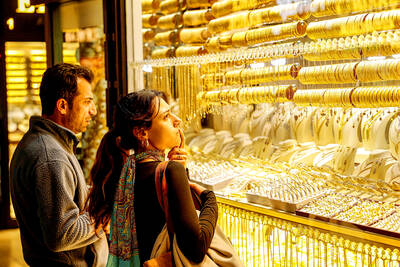
In Italy’s storied gold-making hubs, jewelers are reworking their designs to trim gold content as they race to blunt the effect of record prices and appeal to shoppers watching their budgets. Gold prices hit a record high on Thursday, surging near US$5,600 an ounce, more than double a year ago as geopolitical concerns and jitters over trade pushed investors toward the safe-haven asset. The rally is putting undue pressure on small artisans as they face mounting demands from customers, including international brands, to produce cheaper items, from signature pieces to wedding rings, according to interviews with four independent jewelers in Italy’s main

Japanese Prime Minister Sanae Takaichi has talked up the benefits of a weaker yen in a campaign speech, adopting a tone at odds with her finance ministry, which has refused to rule out any options to counter excessive foreign exchange volatility. Takaichi later softened her stance, saying she did not have a preference for the yen’s direction. “People say the weak yen is bad right now, but for export industries, it’s a major opportunity,” Takaichi said on Saturday at a rally for Liberal Democratic Party candidate Daishiro Yamagiwa in Kanagawa Prefecture ahead of a snap election on Sunday. “Whether it’s selling food or

CONCERNS: Tech companies investing in AI businesses that purchase their products have raised questions among investors that they are artificially propping up demand Nvidia Corp chief executive officer Jensen Huang (黃仁勳) on Saturday said that the company would be participating in OpenAI’s latest funding round, describing it as potentially “the largest investment we’ve ever made.” “We will invest a great deal of money,” Huang told reporters while visiting Taipei. “I believe in OpenAI. The work that they do is incredible. They’re one of the most consequential companies of our time.” Huang did not say exactly how much Nvidia might contribute, but described the investment as “huge.” “Let Sam announce how much he’s going to raise — it’s for him to decide,” Huang said, referring to OpenAI

Nvidia Corp’s negotiations to invest as much as US$100 billion in OpenAI have broken down, the Wall Street Journal (WSJ) reported, exposing a potential rift between two of the most powerful companies in the artificial intelligence (AI) industry. The discussions stalled after some inside Nvidia expressed concerns about the transaction, the WSJ reported, citing unidentified people familiar with the deliberations. OpenAI makes the popular chatbot ChatGPT, while Nvidia dominates the market for AI processors that help develop such software. The companies announced the agreement in September last year, saying at the time that they had signed a letter of intent for a strategic


 RSS
RSS